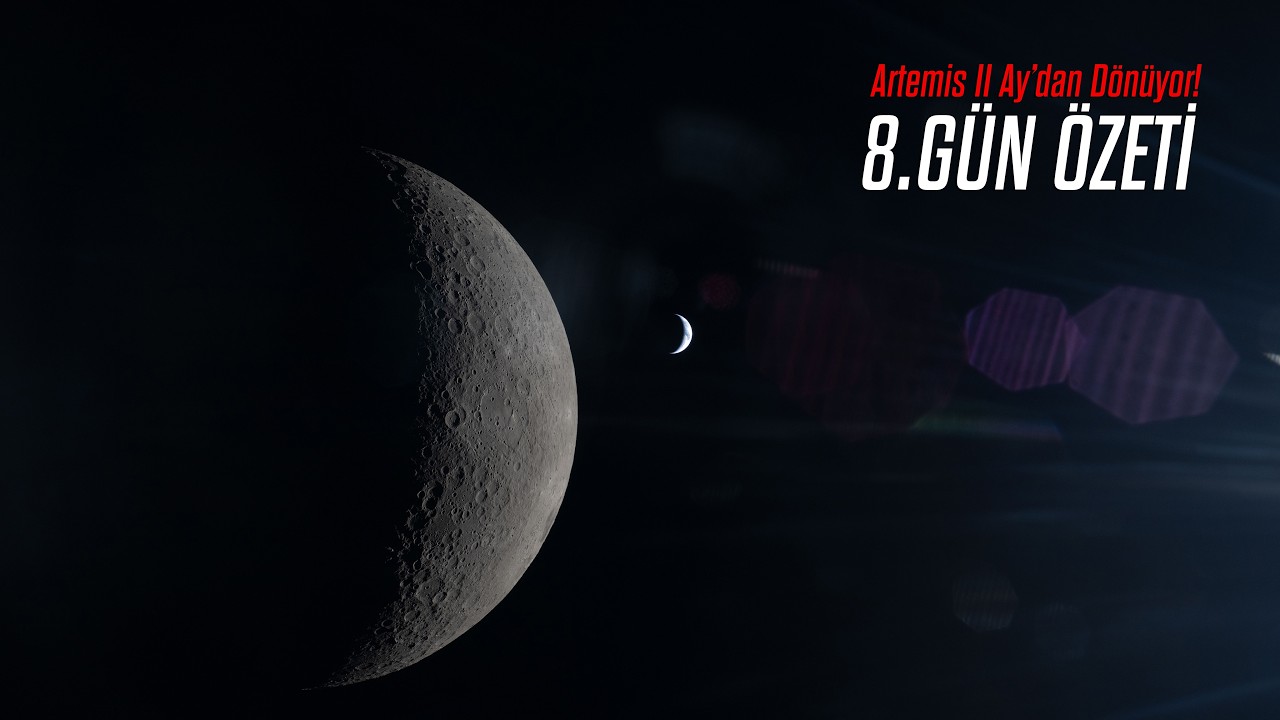
Artemis II - 8. Gün Özeti (Türkçe Altyazılı) Eve Dönüş Hazırlıkları
NASA'nın Artemis II görevi kapsamında 8. uçuş gününde yaşanan kritik gelişmeleri ve iletişim kayıtlarını bu videoda Türkçe altyazılı olarak derledim. Orion mürettebatı, Dünya'ya dönüş yolculuğunda…
NASA'nın Artemis II görevi kapsamında 8. uçuş gününde yaşanan kritik gelişmeleri ve iletişim kayıtlarını bu videoda Türkçe altyazılı olarak derledim. Orion mürettebatı, Dünya'ya dönüş yolculuğunda…
Tam metin Otomatik metin (yapay zekâ, hatalı olabilir)
Good morning from Mission Control Houston here in the Artemis Flight Control Room at the Johnson Space Center. We are coming to you live with our 24/7 continuous coverage of the Artemis II mission. At a mission elapsed time of six days, 14 hours, 51 minutes and counting, I have here beside me Andre Douglas, NASA astronaut, and also CAPCOM, Artemis II crew backup member. You have several job titles.
Yes, I do. It's quite an honor. I'm sure it is. Can you tell us a little bit? You've been kind of a jack of all trades for this mission. Tell us, I saw you close out crew. I've been seeing you here on console. You've trained with the crew. Tell us what you've been up to over the course of the mission. Yeah, so primary job has been Artemis II backup crew. It's been really fun. We do all the different systems training.
We do all the different like module and everything training . It's great. So, you know, some of the things we do is go out to the field and we do geology. And it's actually been a lot of fun going out to Iceland and just experiencing the beauty of the country and learning about rocks. And so that's been amazing. In addition to that, the closeout crew job has been awesome . We work with the exploration ground systems group.
And the whole purpose of closeout crew is to make sure we close the module out, to make sure that we can rescue the crew, to make sure we understand the emergency escape baskets, all of that stuff. It's been exciting. And in addition to that, you know, working on Capcom console, trying to understand what's going on here in MCC and making sure we interact with all the different disciplines and great things that we do.
So it's been awesome. And I'll tie this back to the science. One of the things that's very cool about what we're doing is, you know, for the moon and collecting observations, there is the lunar reconnaissance orbiter that takes pictures around the moon, right? And when we get that, it's a string of images that's going on the longitude, slowly rotating about the axis. And we can't see necessarily that overall view of the moon shot, right?
So now we have a flyby with humans that can get and really use their own minds to figure out what angles are great and when to zoom in, when to not. And we can combine the data from LRO, the orbiter, and now these photos, and now we have this much more complete picture. So just extrapolate that concept out to what would Mars be like and even the base. When you have these different views, you really get an understanding of perspective.
Because one of the things on the moon that the crew talked about was, man, looking at this from a 3D perspective, it really pops out. And you see that at Earth when you're on ISS and you're looking at cloud formations or you're looking at hurricanes, when they're flying by, you know, every 90 minutes they can kind of see how that's changing at an angle. And like that's just something that is really hard to describe.
And you also might see phenomenon that it's hard to see from a 2D perspective or a, you know, a time stamp perspective. So again, with Moon to Mars and being able to put all of these assets together, that's going to give us that just ultimate view. And both spatially and temporally, it's pretty exciting. I'm excited and I'm excited for what the future holds. This mission, I don't know about you, but for me, it's been phenomenal to see the images coming down, to see all of the burns, the crew happy, the eclipse glasses.
I loved it. Yeah, it was awesome. Three, two, one. Good morning, Mars, you! Your friends and colleagues at the Canadian Space Agency wish you another great day on your voyage. Canadians everywhere are inspired by your journey and we're with you every step of the way. Let's go! You're looking live at a view inside the Orion spacecraft, now on flight day eight into the first flight of astronauts aboard Orion.
All four crew members are just wrapping up their post-sleep period, getting ready for the day and getting ready for their daily planning conference. We're expecting that here momentarily when they'll talk down with teams in Mission Control Houston, getting an update on their systems aboard the spacecraft, any plans for today and asking and answering any questions. Again, some of the activities we expect the crew to participate in today include putting on and measuring for their orthostatic intolerance garments or OIGs.
They'll also get in some exercise and we will see them in a couple of public affairs events as well. This is Artemis Mission Control. You're looking at a live view inside the Orion spacecraft of our crew on the Artemis 2 mission. Now a mission elapsed time of six days, 19 hours and 30 minutes. The crew woke up at 10:30 a.m. Central Time today, just completed their post-sleep period and their DPC, their daily planning conference.
Houston Integrity, the CUD valve is closed. We have a good view out the windows. Our crew camera view is only so-so and I'm waiting on your go. I will stop recording. Roger. And the saw view is breathtaking. We love a good blizzard. The less said about the snow, the better. Houston Integrity, we are waving at you out of window two. It's a beautiful blue little crescent out there. Thank you. We can't quite make you out, but we appreciate the thought.
Thank you. We're working on changing that. Thank you, Stan. And while I have you, can we do another jump just for our own purposes? Yes, you may. At this time. Please do. Thank you, sir. That was NASA astronaut Christina Koch reporting to Capcom 's Stan Love and all of us here on the Earth that outside the windows of Orion, she can see us right now. Of course, this is the view looking back on the spacecraft from a camera mounted on one of its solar array wings.
We've been getting beautiful views of both the moon and the Earth as well as incredible views of life inside the spacecraft. You can find all of those on images.nasa.gov and make sure you follow NASA and at NASA Artemis on social media to make sure you don't miss a thing. We've got so much going on. I feel like we're on the International Space Station right now. This is an awesome day here. Hey, can you confirm this is my final exercise of the mission?
It'll just help me with stowage management. That's correct. Okay. Thanks, Stan. And for what it's worth, today's exercise is the last exercise for all crew members. Starting tomorrow, we will not have the time. Integrity Houston for optical comm. Go ahead, Stan. Okay, Lee, long story here. We are still not locked up to optical comm. We suspect solar array blockage. So between exercise sessions, between when you're done and Christina starts, we want to put a 25-degree roll on the vehicle, about a one-minute maneuver to an attitude where we think optical comm can see the ground terminal.
And then we'll have the time to move on to the other side. And we'll have the time to move on to the other side.
You can see some of those maneuvers happening right now.
Again, targeting to sync up with Opcom, the optical communications. This is a live view from the spacecraft. Looking at the service module, this video coming from a camera mounted on the tip of Orion's solar array wing. There are four solar arrays. Each solar array could panel two three-bedroom homes. Integrity maneuver and damping complete. We are go for crew exercise. We're going to go for crew exercise.
And we're going to go for crew exercise. We're going to go for crew exercise.
And we're going to go for crew exercise. We're going to go for crew exercise. So we're going to go for crew exercise. We're going to go for crew exercise.
Thanks for the words and the cheers. That was Commander Reed Wiseman calling down that they have finished exercise for the mission. And that's worth celebrating. Integrity Houston, no action on the enabled caution. That's part of our cabin repress. It should clear on its own soon. Copy. Thanks, Stan.
NASA astronaut and capsule communicator Stan Love calling to the crew aboard the Orion spacecraft. They received a caution about their cabin pressure. However, it was -- it will clear out on its own after the oxygen levels out inside the cabin. We are currently repressurizing Orion. There was a demonstration flight test objective to have the cabin pressure at 10.2 PSI. That repressurization has been going on for about an hour and a half now.
And the pressure is currently at 13.27. We're currently at a mission elapsed time of seven days and six minutes, meaning it has officially been a week since Orion launched to fly around the moon and come back home to Earth targeting that splashdown in two days, one hour, 25 minutes in the Pacific Ocean. We do expect to see the crew and hear from them shortly during the Canadian Space Agency Public Affairs event.
That will be in about 40 minutes. We got you loud and clear, Josh. Great to hear your voice. We got Jenny and Capcom and it's great to have you on board Integrity. Thanks for joining. Thank you, guys. We're good. Thank you. Jeremy, and to your crew aboard, we have a very special guest tonight who would like to say a few words to you. And so, it was a great pleasure that I would like to pass the word to Mark Carney, Premier Minister of Canada.
Mark Carney: Well, thank you very much, Joshua. And first of all, Jeremy, I want to start in French because all Canadians and Canadians are so proud of you for many reasons. It was incredible to hear you in French for the first time in the space. And as I say, Canadians are so proud of what you're doing and the collaboration. And I just want to have a chance, if I may, I mean, I'm thrilled. I'm absolutely thrilled to be speaking with you, Jeremy, and the crew.
We've all been watching and inspired. Jeremy, and Terry Houston, cabin repress is complete, 14-7. And we'll stay that way for the rest of the mission. Stan, we definitely appreciate that. And you should probably just carry a note forward for future Artemis missions. If you do a large repress like that, there are certain things such as CCUs that collapsed pretty significantly during that no damage. But there are some things we probably would want to vent along the way as we come back and pressure.
Received loud and clear, Reid. We'll take that note. That was Commander Reid Wiseman calling down to the ground. We did conduct the cabin repressurization today. The cabin pressure was kept at 10.2 psi for an extended period of time as part of a test aboard the spacecraft as this is a test flight. The first flight of humans aboard Orion. Everything we learn is helping us prepare for future missions.
Houston Integrity calling the blind from a Peltor. And just doing a test for the Peltor noise reduction flexible activity. These actually work really well. We have three crew members on Peltors, one in the toilet. And we're using the Bluetooth feature to talk between them. And they sound really good. Noise cancelling makes them very quiet. And then talking to each other with push to talk on the headsets.
This is Artemis Mission Control in Houston, Texas. You just heard NASA astronaut Victor Glover call down from the Orion spacecraft. You can see a live view of that Orion spacecraft. He noted that he was making a call in the blind, which means that he knows that the team here cannot respond to that call because we are currently in a forward link loss of signal. This is Artemis Mission Control. Following that brief data rate change, we now have those live views back of the crew inside the Orion spacecraft.
Again, they're working through some stowage activities to start preparing for reentry prep. They will do a lot of their reentry preparations tomorrow when they will be reconfiguring the cabin to prepare for splashdown. And they will also be studying their entry procedures. In addition to stowing some of their equipment, they will also be installing their seats to ensure all items are secured for reentry.
We all just had that weird vibe of backing up that we were getting sad. Aww, we feel it too, but we'll be happy to have you back. Awesome. Let me have a look and we'll let you know if we have anything we can tee up for you now. Otherwise, we'll wait for it to schedule. That sounds great and Victor's spinning is making us giggle . It's really spectacular. Integrity, this is NASA PAO Courtney Beasley. How do you hear me?
Hey, Courtney, we hear you, but you are very low. Courtney Beasley: Okay, I will try to talk a little bit louder. Reid, Victor, Christina, and Jeremy, it's great to see you today. We have a room filled with media, eager to talk to you. Courtney Beasley: Courtney, we have you loud and clear. Courtney Beasley: Wonderful. We have a room full of media ready to talk to you today, and we also have them on our phone bridge. We have a limited amount of time, so we're going to go ahead and hop straight into questions. We'll start here in the room with Marsha Dunn. Go ahead.
Marsha Dunn: Marsha Dunn, Associated Press for URED. Could you please describe your emotions when Jeremy called down to Mission Control to ask permission to name a lunar crater after your late wife, Carol? It was a pretty emotional, powerful moment down here. Mark Adams: Marsha Dunn: Marsha, it was a powerful moment up here as well. My crewmates approached me when we were at Kennedy in quarantine, and they said, "Hey, the three of them had talked, and they would like to do this," and that was an emotional moment for me, and I just thought that was that was just a total treasure that they had thought through this, and they had offered this, and I said, "Absolutely. I would love that. I think that's just the best," and I said, "But I can't give the speech. I can't give the talk," and Jeremy, the kind of guy he is, he said he would do it, and it was getting emotional there, and I think when Jeremy spelled Carol's name, C-A-R-R-O-L-L , I think for me that's when I was overwhelmed with emotion, and I looked over and Christina was crying. I put my hand down on Jeremy's hand as he was saying it was right there on that rail, and I could just tell he was trembling, and we all pretty much broke down right there, and just for me personally, that was kind of the pin nacle moment of the mission for me.
That was, I think, where the four of us were the most forged, the most bonded, and we came out of that really focused on that day ahead. I think that was a very c aging moment for the four of us. Thank you for that question, and it was a great moment. And we have seen just some extraordinary things, things that I thought we might see. They looked similar to what I thought they might look like, and other things that I just had never even imagined, and those were different perspectives that we saw these things from, but I have to say it hasn't changed my perspective or the perspective that I launched with, but the perspective I launched with was that we live on a fragile planet, in the vacuum, in the void of space. We know this from science. We're very fortunate to live on planet Earth, and the other perspective that I've sort of learned from others through life is that they're, you know, our purpose on the planet as humans is to find joy, to find the joy in lifting each other up by creating solutions together instead of destroying, and when you see it from out here, it doesn't change it, it just absolutely reaffirms that. Houston integrity for a quick, kind of a PAO item, but more of a item for the folks in the control room there. Go ahead.
Do you have our video still? We do. Not sure if it made it in the handover, but this morning, we were asked to go unpack a very special item, and we just wanted to, we wanted to share it in that PO event, we just didn't get an opportunity to do so. So we're going to share with you all, because we need to share this. Like this has to be shared, right? So in Victor 's hands here is, it is the Apollo 18 flag that the agency asked to have put on board Artemis II so that it could take its rightful trip around the moon. And the four of us are just honored to have this here. We're honored that it is in our presence, that it is in our presence. And we are honored to carry the torch from Apollo through Skylab, through the space shuttle, through our beloved International Space Station, and now back further than humans have ever gone around the far side of the moon and safely home back to Houston. So we just wanted to share this with you because it needed to be shared. Thanks. Carrying the torch indeed. Thank you for sharing it with us in the world, and we'll look forward to welcoming you and that flag back to Houston shortly.
Thank you.