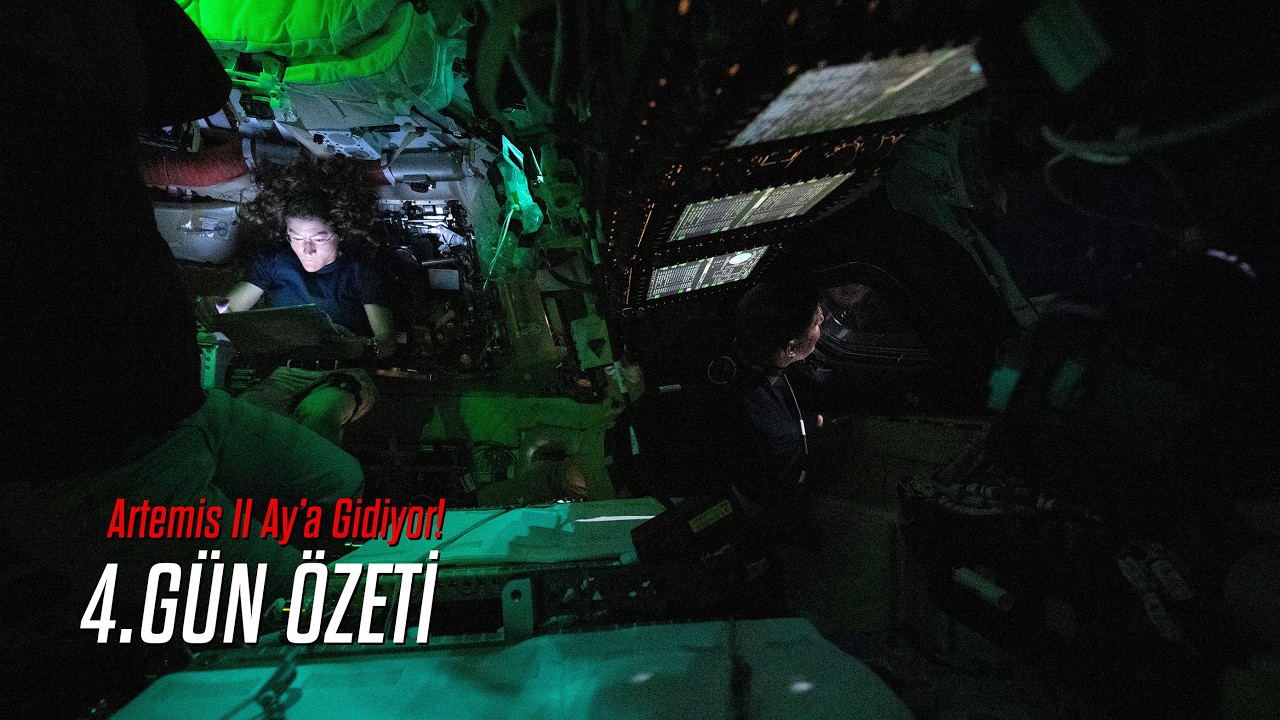
Artemis II - 4.Gün Özeti (Türkçe Altyazılı) Tarihin En Uzak Röportajı ve İrtifa Referans Değişimi
NASA'nın Artemis II görevi kapsamında 4. uçuş gününde yaşanan kritik gelişmeleri ve iletişim kayıtlarını bu videoda Türkçe altyazılı olarak derledim. Orion uzay aracının irtifa referansı resmen…
NASA'nın Artemis II görevi kapsamında 4. uçuş gününde yaşanan kritik gelişmeleri ve iletişim kayıtlarını bu videoda Türkçe altyazılı olarak derledim. Orion uzay aracının irtifa referansı resmen…
Tam metin Otomatik metin (yapay zekâ, hatalı olabilir)
This is Mission Control Houston from inside the Artemis Flight Control Room here at the Johnson Space Center. We are at a mission elapsed time of two days, 17 hours, 58 minutes and counting. The Orbit 3 team of flight controllers is currently on shift in Mission Control and we are gearing up for crew wake at a mission elapsed time of two days, 18 hours, as well as a handover to our Orbit 1 team of flight controllers.
The Orion spacecraft is currently 168,000 miles and counting away from Earth and 110,000 miles away from the moon. While the crew has been asleep, we have received some down linked images from Integrity. So let's take a look at them. Here we can see Commander Reed Weissman through Orion's window. We can see him looking out watching the Earth grow smaller and we're all reminded that every single giant leap begins with leaving something familiar behind.
Let's go over to our next image. And there we have Mission Specialist Christina Koch looking at our blue marble that's giving us some perspective on humanity's innate need to explore. Very inspirational photos coming down from the crew while we wait for them to wake up in just under a minute from now . For now, this is Mission Control Houston. Good morning. There's a couple items I did want to talk with you before we got too much of the day going.
So if you had a couple minutes, I had a few big picture words. Yeah, go ahead, Mike. Big picture today, we have canceled OTC2 burn. We are replacing it with some maneuvers and a check out of the wastewater dump. So at 18:35, about 30 minutes from now, we're going to maneuver to an attitude that will put the sun onto that wastewater vent line. We have increased the heater temperatures on the nozzle and the lines themselves.
And we're hoping that if the problem is the freezing of the vent lines, why we couldn't do the wastewater dump last night, then this will give us a chance to see if we were able to solve that. This is Artemis Mission Control. Mission elapsed time, two days, 18 hours, 45 minutes into the flight of Artemis II, the first flight of humans aboard the Orion spacecraft. You're getting a live look outside Orion right now.
The teams are maneuvering the spacecraft in the solar array wings. As you heard earlier, we are not having the outbound trajectory correction burn today. This was deemed unnecessary and has no impact to the mission or the lunar flyby. The translunar injection burn put the vehicle on the correct path back on flight day two. And therefore, the team and mission control agreed that we could skip both outbound trajectory correction burn one, as well as that second burn today.
Skipping that second burn also allows the team to continue troubleshooting some of the universal waste management system issues that cropped up last night. There was a wastewater dump planned last night, a very routine and regularly scheduled action, and it terminated after only dumping 3%. So the wastewater tank is not currently full. It is at 64% with a limit of 80%. But the crew was instructed to use backup collection devices overnight if they needed.
Part of the reason for reorienting the spacecraft today is to allow it to be in the sun, specifically where the primary vent nozzle is. They are hoping that spending some time in the sun will help thaw out potential ice that may be on that vent nozzle . Meanwhile, inside the Orion spacecraft, our crew just woke up that wake-up coming at 11:35 AM Central Time. We have a small request for you guys. With this attitude that we're using for the bake-out, we're getting the sun on the window shades and we're a little worried about them heating up too much.
We would like to request that you please remove the window shades. We understand that will make it awfully bright for you guys and we want to encourage you to use a T-shirt in the cabin or something similar if needed to block out that sunlight. But the shades will help us with the temperature constraint on the windows. Okay. So we have our makeshift T-shirt on window one. Is that one okay to stay up then based on what you said and we'll take off the window two shade?
The other ones are already off. That sounds great. Thanks, Chair. Huntsville, integrity for avatar. And integrity, Huntsville is with you. Yes, good integrity morning. I think it's afternoon for you . Avatar lights to report. All lights are on ON except for 1515. Okay, we copy the same status as yesterday. All lights on ON except for 15. You recently heard a call from NASA astronaut Christina Koch, mission specialist on the Artemis II flight, down to the Mission Control Center at Marshall.
This was to the payload operations director who leads science execution for the Avatar payload, which is specifically what she was referencing. Avatar stands for a virtual astronaut tissue analog response. This is part of our strategy to get a holistic understanding of how the deep space environment affects humans. So this is organ on a chip technology. It's about the size of a USB thumb drive, and it measures how individual astronauts respond to deep space stressors.
These organ chips contain cells that were developed from preflight blood donations from the crew. For this research is to validate whether those organ chips can serve as accurate tools for measuring and predicting human response to stressors. So scientists will be comparing these Avatar findings with space station findings, as well as with those samples taken from the crew before and after the flight.
So scientists will be comparing these to the crew.
NBC News, this is Mission Control Houston. Please call Integrity for a voice check. Integrity, this is Tom Costello with NBC News. Are you hearing us okay? Hey. Hey, Tom. It's great to hear your voice all the way up here. 155,000 nautical miles from Earth.
How are you doing? I'm well. Congratulations on your mission so far. I'm told this is the farthest interview ever conducted in history. And I'm wondering how does it feel right now to be in a place that nobody has been since 1972? Honestly, it is unbelievable that we in 1972 just being up here and seeing how difficult this is and how hard the team is working. We do have a little bit of echo on your call.
We'll try to turn it down when we're answering. But this is just a magnificent accomplishment to be up here to see the moon, to see the Earth, and to know that we are between those two celestial bodies. And you can see it when you look out the window. The Earth is almost in full eclipse. The moon is almost in full daylight. And the only way you can get that view is to be halfway between the two entities.
It's just -- it is truly awe-inspiring up here. I think as we go into Easter Sunday thinking about, you know, all the cultures all around the world, whether you celebrate it or not, whether you believe in God or not, this is an opportunity for us to remember where we are, who we are, and that we are the same thing and that we've got to get through this together. This is Artemis Mission Control at Johnson Space Center in Houston, Texas.
We have now reached exactly three days since the launch of Orion. We just heard the call to the crew that the solar arrays are in motion ahead of taking a photo. We're looking to get a picture of the crew in the windows of Orion. Photos are the priority of this event, so we'll stand by to see if we still have streaming. But regardless, we will be very excited to share those photos with you as soon as we possibly can.
Make sure you follow NASA and NASA Artemis on all social media. That would be @NASA and @NASA Artemis. Integrity Houston, our saws are in position to take this family portrait. So sometime in the next few minutes, we'd love to invite you to the windows to get it done. Thanks. All right, everybody. We're taking the pictures. So stay cheese and stay still for about 30 seconds while we perform this photography bracket from the saws.
Okay, we'll freeze in 3, 2, 1, mark. The Integrated Communications Officer, or INCO, is helping take this picture of the crew aboard the Orion spacecraft. Now all smiling in the windows of the place they've called home. We've had some great views both inside the spacecraft as well as outside, but this is the first time that we're getting to see the crew and the spacecraft in the same photo. As mentioned previously, we are taking pictures right now, so the streaming quality isn't as great.
We look forward to sharing these pictures as soon as we possibly can. And make sure you follow NASA and NASA Artemis on social media. It's taking a little longer than we thought. Thanks for holding. All right, everybody can relax. That was great. Thank you so much. We all look forward to getting your Christmas card come December. Thanks. On your screen, a live view of the Orion spacecraft looking at the moon.
Our destination now 96,575 miles away. On the left side of your screen is Canadian Space Agency astronaut Jeremy Hansen, and to his right NASA astronaut Christina Koch. During this demonstration, the crew will be able to manually pilot Orion once again and test its six degree of freedom and three degree of freedom. If you look closely in the background, you can see NASA astronaut and pilot Victor Glover filming part of this demonstration.
All right, I'm just giving you some handling qualities here for the yaw. Everything was nominal. I noted that with this orb mount, it does have some play in it as we knew, and so just applying some downward force to try and make sure you don't get coupling is required, but that's fine. That's workable. And then we had a little bit of coupling and roll, both in the same direction on that one. So we had about four degrees of roll through the 20 degrees of yaw.
Copy all? Okay. We just finished the three DOF maneuvers. The rates all seemed the same. The response seemed the same . It is difficult to tell whether you might be -- you might have some cross coupling from the RHC or if it's from the vehicle, but we were pretty convinced in the last roll one that the coupling that showed up, which was four degrees, was coming from the vehicle and not the RHC. So the vehicle overshot by seven degrees once it was released from the yaw left, and then it built up very slowly, built up a rate, and it looks like it's trying to take it back to where the RHC was released, but it's overshooting again.
Copy all? And Jenny, we are going to switch pilots now. This will be myself in the seat and making comments. Copy. We're following the swap. Thank you. And currently on your screen you can see CSA astronaut Jeremy Hansen and NASA astronaut Christina Cooks swapping places. As they continue through the manual piloting developmental flight test objective. Again, they are performing several different attitude maneu vers to compare six degrees of freedom and three degrees of freedom attitude control on the spacecraft.
Six degrees of freedom refers to the six ways that a spacecraft moves. There are three translational degrees of freedom: forward, backward, up and down, and left and right. And three rotational degrees of freedom, which are roll, pitch, and yaw. Okay, I'm going to make a comment on the pitch up. There was some roll there. I tried a different technique where I actually kind of held the orb mount at the high end of its play rather than pressing down at the low end since I was pitching up.
But I think that actually made it a little bit harder to keep the roll coupling out. So for pitch down I'll go ahead and hold it at the bottom of its play. So in this, again, in the direction, in this case, of the pitch. Copy, y'all. And Houston, we have some Earth and Moon viewers here who are putting in requests for different motions so they can see things in the window. We're seeing them in the camera views and we're enjoying it .
Look at those scientists go. Not too long ago they did surpass the two-thirds mark as they continue to close in on the Moon and they are expected to make that closest approach in their lunar flyby on flight day six coming up on April 6th. Absolutely. One of the neat things that I'm seeing right now is in the sort of largest mare field, the one that sort of makes up most of the very western side of what you can see on the near side.
There is a giant -- it's much more obvious now that one of those mares is a huge basin because it's just right now it's kind of at the one o'clock position. And I don't know the name of that big one. It's basically just west of where Seriantatus and Tranquil itatis are. But it is phenomenal. And the Moon we are looking at is not the Moon you see from Earth whatsoever. And Victor is absolutely mesmerized by Oriental through the 400 lens.
He says that not only in Oriental but all around the basin you can actually see the terrain. It's not an albedo change. It's not shadows. You can actually just tell that they are terrain features of the multi-ringed crater there. Christina, we copied all of Victor's Oriental observations. That sounds amazing. And we think based on your description of the basin that you saw, that is imbrium. Yes, that sounds right.
I've never noticed that imbrium has such a distinctive high albedo ring defining it. Also worth mentioning, we do apparently have a full Moon. We can't detect any Terminator at all. It looks like full limb all the way around. And Jackie, we got Jeremy on there just for a minute before his PAO event. He's just got to look at this. As soon as I put my hands on the 400, it's just, you know I 'm not one for hyperbole, but it's the only thing I could come up with.
Just seeing Tycho, there's mountains to the north. You can see Copernicus, Rainier Gamma. It's just everything from the training, but in three dimension and absolutely unbelievable. This is incredible. Kathy Moonjoy. And Houston, I can tell you that Christina now has the 400 millimeter, and she also is the queen of hyperbole. It's incredible. Wow. Kathy, Christina doing her best read impression at the window.
Yeah, I just wanted to make one kind of correction to what I mentioned before. I do think that we have a Terminator. It is on the far western edge. It's not actually a limb. It's almost on the Terminator all along what, it's basically almost in the same places where you would imagine the limb to be. But it's a very high albino as you would expect from the far side, and you can see the topography all along the Terminator.
It's awesome. Houston integrity for altitude reference change moment. Go ahead. Jackie, with that incredible viewing behind us of our destination in the near term, we hereby change our DU PFD altitude reference from Earth to Moon. We are currently 76,362 nautical miles from the Moon. And from Earth we had been 168,000 nautical miles. Houston copies. Thank you.