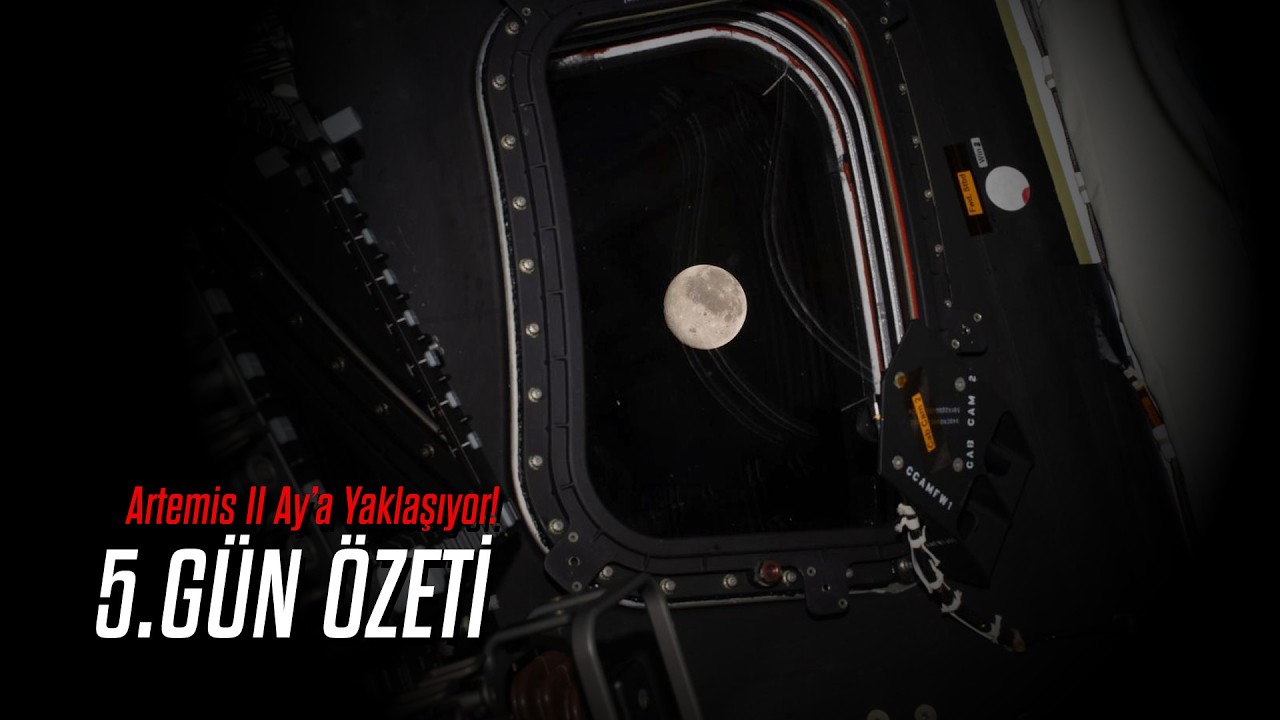
Artemis II - 5. Gün Özeti (Türkçe Altyazılı) Ay Geçişine Son Hazırlıklar
NASA'nın Artemis II görevi kapsamında 5. uçuş gününde yaşanan gelişmeleri ve iletişim kayıtlarını bu videoda Türkçe altyazılı olarak derledim. Ekip, 6 Nisan'da gerçekleşmesi planlanan Ay geçişi…
NASA'nın Artemis II görevi kapsamında 5. uçuş gününde yaşanan gelişmeleri ve iletişim kayıtlarını bu videoda Türkçe altyazılı olarak derledim. Ekip, 6 Nisan'da gerçekleşmesi planlanan Ay geçişi…
Tam metin Otomatik metin (yapay zekâ, hatalı olabilir)
Hello, Reed, Victor, Christina, and Jeremy. This is Apollo 16 astronaut Charlie Duke. John Young and I landed on the moon in 1972 in the lunar module we named Orion. I'm glad to see a different kind of Orion helping return humans to the moon as America charts the course to the lunar surface. Below you on the moon is a photo of my family. I pray it reminds you that we in America and all of the world are cheering you on.
Thanks to you and the whole team on the ground for building on our Apollo legacy with Artemis. Godspeed and safe travels home. All right, Reed, we will put in work right now, so we're going to hop on PCD1. It was great working with all of y'all. I'm handing over here to Jam shortly, and this is my last shift here with y'all, so it's been a great pleasure. Y'all are doing awesome, and can't wait to see y'all back stateside.
Thanks, Mike. Absolutely excellent. If you want to do one final contact, we can switch over to any OE that you want. We can do as many as you want. And then one parting word, if you could please contact Frank Rubio and have him tell my kids to start emailing the other crew members here so that I can at least talk to them. That would be a huge, huge help. Thank you. Hey, Reed, that's a simple thing.
I'll make sure it gets done. Have a good one. Mike Integrity Comcheck. Oh, Christine, I got you loud and clear. How about me? Yeah, buddy, we have you the same. It's been great working with you. Thank you for all the help and support. For sure. Y'all have been amazing. I've loved every minute of it. Good morning. Good afternoon. Happy Easter to all of you who celebrate. And welcome to the Artemis Mission Control Room here at Johnson Space Center in Houston, Texas.
We are starting flight day five. The astronauts just woke up at 11:05 a.m. Central Time. Currently, the teams are handing over from the Orbit 3 team to the Orbit 1 team led by Jeff Radigan here in Mission Control. It's going to be a busy day for the crew with their ox suit demo in which they will be donning their spacesuits rapidly as if they were in an emergency. Currently, Orion is over 63,000 miles away from the moon, 215,000 miles away from our home planet Earth.
We are MET mission elapsed time, three days, 18 hours, and 28 minutes. We are going to be able to get to the crew. Integrity crew, we are rolling Orion by 20 degrees to improve optical calm. Those communications you just heard called to the crew were from CAPCOM Jenny Gibbons. She is a Canadian Space Agency astronaut and backup Artemis II astronaut. She'll be the voice you hear speaking with the crew from the ground today.
That information was about the optical communications system, letting the crew know that they are going to maneuver the spacecraft to get better pointing for that optical communications. This opcom system allows the team to transmit science data, procedures, flight plans, communications, and more from -- as a link between Orion and Mission Control. These are laser communications, so they use infrared light rather than traditional radio waves, and that allows more data to be sent.
Integrity, you are welcome to come on board. Copy, Christina. We are on board with you. Thank you. You're looking at a live view inside the Orion spacecraft, now just 61,919 miles away from the moon, the destination of this flight, and where they will arrive for the flyby tomorrow. As we get a live look inside the cabin closest to the camera, NASA astronaut Christina Cook and behind her Canadian Space Agency astronaut Jeremy Hans en, his first flight to space.
We are entering flight day five. the crew is still in their post-sleep period and config uring the spacecraft for the day's events. Immediately upon wake up and before the astronauts brush their teeth or exercise they are asked to take a saliva collection. Saliva provides a unique window into human immune system functions in a deep space environment so dry saliva is collected before during and after the mission. The crew blots it onto special paper in pocket-sized booklets.
Go ahead. Yeah low priority can you please tell me a good stow location for the two lens caps? I looked up lens cap in the packing plan and wasn't able to find anything. Thanks for the help. Low priority. Copy Christina. IVA is looking at it. As we've seen throughout the mission the crew will call down when they need to find something or when they need to store something. Everything aboard the spacecraft is tracked so it can be easily accessible or easily stowed and found later.
Houston Integrity good morning and happy Easter to everyone down on earth. We wanted to kick off our Easter Sunday by honoring our crew mate Jeremy Hansen. We have a long-standing tradition in the astronaut office of the traditional astronaut pin and when you fly in space you change from silver to gold. And so we figured today was a perfect day to honor our friend Canadian astronaut Jeremy Hansen with his flown Astro pin.
Wow. That sounds like it took a lot of people to make this little representation that we have in the office. This tradition come to reality for me. So a lot of gratitude for all those people. It's a pretty special experience. Thanks for doing this guys. Congratulations. Well deserved. It's an honor to fly with you Jeremy and to be here when you get your gold astronaut wings. We wanted to take a minute to commemorate the holiday that we have. This time of year is something that many religions and many cultures hold dear. It's a time of emotions such as joy as well as solemnness honoring honoring what's going on both in our world and in our religious beliefs.
Another aspect of that is our family traditions. And I know for me if I was on the earth right now I would be with my family in Houston the Monta Rosas and we would be hiding confetti eggs in the backyard and watching two very sweet little girls go try to find them. So to commemorate that on board we did hide a few eggs around the cabin. They were the dehydrated scrambled egg variety but we're all pretty happy with them.
That's wonderful. We'll keep an eye out. Yes. First I wanted to just say happy birthday to my father Victor Glover Sr. and happy Easter to everyone down there on earth. And with that I will pass it off to Jeremy. Thanks Victor. Happy Easter everyone. We were talking up here as a crew and we did want to send a special Easter message on this day. And you know no matter your faith or religion for me the teachings of Jesus were always a very simple truth of love, universal love.
Love yourself and love others. And something for us being up here and looking back at all of you through one tiny window is that just resonates 100% true. And our goal as humanity should be to just follow in that example. There were many examples in the past but that's one example of love that we can just all follow in those footsteps and it'll serve us well. And with that Houston we are eager and ready to start our exciting day of suit offs with you all. And we don't have any specific comments yet.
But ready to hear what you've got for us. Thank you integrity. A lot of gratitude for that message down here and it's wonderful to see Jeremy get that pin. So thank you for sharing with us. Inside the cabin the spacecraft or the crew is preparing the spacecraft for the OX suit demo. Orion Crew Survival System suit. That's what OX stands for. Today they will be donning their suits or getting into those suits.
Two will be doing so rapidly and two will be doing so at a normal pace. These suits are what the crew members wear during launch and reentry. It's also what would protect them in the event of a depress urization in the spacecraft. These Orion Crew Survival System suits could keep the crew member wearing it in a breathable atmosphere for up to six days if Orion were to depressurize. Now this is obviously the first time that humans have ever flown aboard Orion so the first time we've gotten the opportunity to test out these suits.
So after they put on the suits they will pressurize them and then they will install their seats. They uninstalled their seats following arrival on in their high earth orbit. And with these suits being pressurized that seat install would be a little more difficult. Jenny we are ready for the position to latch the leg assemb lies onto the seat backs for one and two. For both seats one and two you are looking for the seat pan position.
You will be putting the pit pins in position three and seven for both seats. Jams we are nearing the time of having you all go off board so that we can get into our suits. Just wanted to check in with you on timing or anything else you've noted that you want to share before we get into that . Thanks for letting us know Kristina. Kristina that syncs with everything that we've been tracking. We just want to update you that we don't believe that we will do any objectives at the lower pressure.
So at 3.7 PSID at your suit delta pressure and we're also looking at adjusting the objectives during the first set as well. So we'll continue to talk about that and in the meantime you're going to continue. Thank you. As part of this test we have vented some of the cabin pressure overboard.
It is now 11.0 psi inside the cabin. Again, today we are conducting a demonstration of these crew survival system suits. Now that the suits are pressurized it can be more difficult for the astronauts to maneuver about the cabin. They are obviously also connected to umbilicals which make another hurdle into moving around the spacecraft. The crew will soon be moving into their midday meal period. And then later this afternoon having the OTC-3 burn, that's outbound trajectory correction 3.
We did cancel OTCs 1 and 2. These small outbound trajectory correction burns help keep us on the proper trajectory for our lunar flyby and our return to Earth. Integrity, we have you the same. Please execute procedure 2, decimal 1, decimal 0. Cabin leak suspected. We need to get the cabin pressure control to maintenance. This will perform a cabin O2 introduction. Again, we are working on getting the crew audio back into the broadcast but you heard Capcom Jenny Gibbons, CSA astronaut and Artemis II backup communicating with the crew some of our recent changes on the spacecraft.
As we went into the LOS with the crew, that loss of signal which we were expecting, we also noticed a cabin fan change which caused a cabin leak suspect warning. There was no cabin leak. We needed to mow back to a maintenance option and reintrodu ce oxygen into the cabin. All right Jenny, the moon is decidedly large up the window today. We can see all of Apollo, I'm sorry, all of Oriental, angular ring.
We can see, I'm 99% sure, Ohm. See Pierazo very easily and just getting over, can't quite pick up Vadoff yet but that far side that is right on the limb is extremely mountainous. Trying to get some pictures but it's a high grazing angle but it's pretty awesome to just look out and see all of these sites and it's bright but very visible with the naked eye. Still primarily seeing whites, grays. Maybe I can convince myself on the far side there's some just hues of brown, very light, very, very faint.
But it's a great view, it's beautiful. And on the near side, Aristarchus is by far the most prominent feature. It is really just glowing bright right now. That's beautiful, Reid. Thanks for bringing us all up there with you. And for the science team, Pierazo and Aristarchus have the same albedo level right now. They're the same level of brightness. And then looking down, Copernicus is just a little bit dim mer but it's close.
Houston Integrity, just one other observation. Looking at the Terminator, it's almost a full moon from this perspective. We've got the Terminator on the western edge of the moon. About one oriental diameter from oriental. And just with our plain eyes, you can really start to see topography. There is elevation on the moon, not just variation in color . And that already makes the moon look wildly different.
Houston Integrity, confirming your go/no-go for this burn. Houston, MCC has pulled go for the burn. Houston, MCC has pulled go for the upcoming outbound trajectory correction burn 3. This burn expected to take place in about 26 minutes from now. And it will be an approximately 19 second burn using the auxiliary engines on the Orion spacecraft. There were previously two other outbound trajectory correction burns on flight days 3 and 4.
That ended up being canceled as it was determined they were no longer needed. Due to the accuracy of the trans lunar injection burn on flight day 2. However, the team decided to go ahead and execute this out bound trajectory correction burn 3 today on flight day 5 to ensure an accurate trajectory as the spacecraft begins to make its way around the moon and back to earth to minimize further larger trajectory corrections that may be needed on the return journey.
Integrity Houston, maneuver to burn attitude starting in about 3 minutes. Integrity Houston, we're in burn attitude. We see the same. This is Artemis Mission Control in Houston, Texas. We just heard that confirmation called up to the crew on board the Orion spacecraft. The spacecraft has maneuvered to the correct burn attitude in preparation for the upcoming outbound trajectory correction 3 burn scheduled to take place in about 5 minutes from now.
We're going to be able to see the next 10 seconds.
And we have confirmation that that outbound trajectory correction burn is now underway. And we now have confirmation that that burn has completed. Again, that was an approximately 19 second burn using the auxiliary thrusters on the Orion spacecraft service module. That burn completed at 10:03 PM Central Time, 11:03 PM Eastern Time to further fine tune the Orion spacecraft's trajectory as it continues to make its way around the moon.
And it was a good burn. Integrity Houston, good burn. We are assessing the details. Good news. And we see the same. Thanks, Mark. Great to finally do a burn. I know. A nice, beautiful little burn, too. And we'll be advised we are maneuvering for opportunistic science. You would need to configure your D5 and Z9 cameras for that , like yesterday. We are tracking and looking forward to it very much.
We had a gorgeous view of a very big moon right out of window two during that burn. Well, right before the burn, before we maneuvered, it was awesome. And it looks like we'll be back at window two for this as well. This is Artemis Mission Control. About seven minutes ago, the Orion spacecraft executed the outbound trajectory correction three burn to fine-tune the trajectory of the Orion spacecraft as it continues to make its way around the moon with that lunar flyby planned for tomorrow on flight day six.
Now that that outbound trajectory correction burn is complete, teams will be maneuvering the Orion spacecraft into an attitude to be able to capture some opportunistic imaging of the moon. Thank you.